

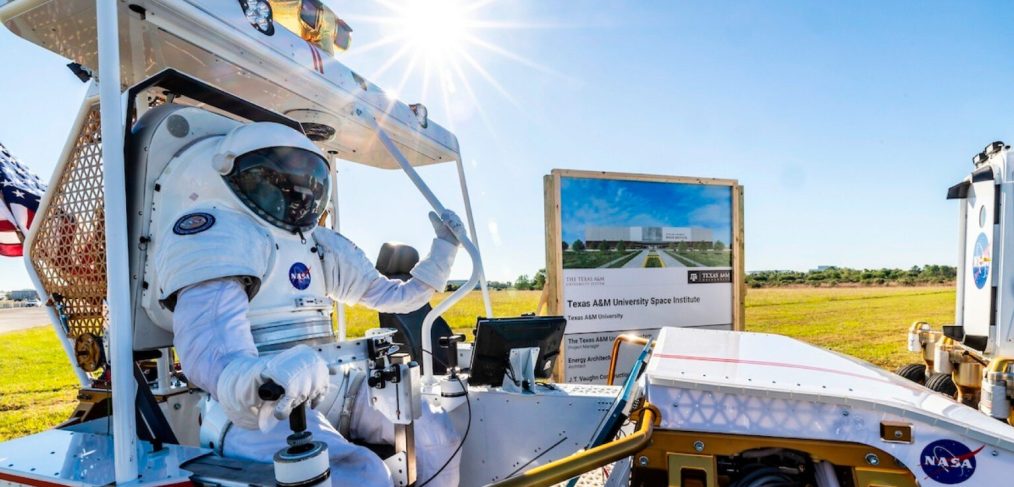
Texas Space Grant Supports Design Challenge for a Next-Generation Lunar Terrain Vehicle
| The Texas A&M University System is quickly building one of the most expansive university-led space enterprises in the United States. From microbes floating in orbit to a $200 million lunar training ground rising next door to NASA’s Johnson Space Center, A&M System members are advancing astronaut training, radiation protection, satellite engineering, autonomous systems, and workforce development. Together, they are helping position Texas and the United States at the forefront of the next era of space exploration while preparing the workforce needed to sustain it.
TEXAS A&M UNIVERSITY SPACE INSTITUTE
The Texas A&M University Space Institute will be the centerpiece of the A&M System’s growing space enterprise. Set to open in fall 2026, the first-of-its-kind research facility is rooted in collaboration, discovery, and training, bringing government entities and private-sector partners together under one roof to perform space-related research side by side. The institute is being built in NASA’s Exploration Park, a 240-acre property adjacent to Johnson Space Center in Houston, and will be the first tenant in that development. It is funded through a $200 million initial investment from the State of Texas, part of a $350 million space and aeronautics package approved by the Texas Legislature in 2023.
The 400,000-square-foot facility will house the world’s largest indoor lunar and Martian surface simulations, high-bay laboratories, research garages, and multifunctional project rooms. It is led by Director Dr. Nancy Currie-Gregg, a former astronaut with four space shuttle missions and roughly 1,000 hours in space, alongside Associate Director Dr. Robert Ambrose. Early private-sector partners include lunar-rover developer Venturi Astrolab and lunar-lander company Intuitive Machines. When it opens its doors, the Space Institute will support applied research and development, planetary science, mission concept development and training, and workforce development, establishing Texas as the global leader in advancing humanity’s future in space.
Read the full article on news.tamus.edu
Author Credit: The Texas A&M University System
Image Credit: The Texas A&M University System
Original Post Date: 6.1.2026