

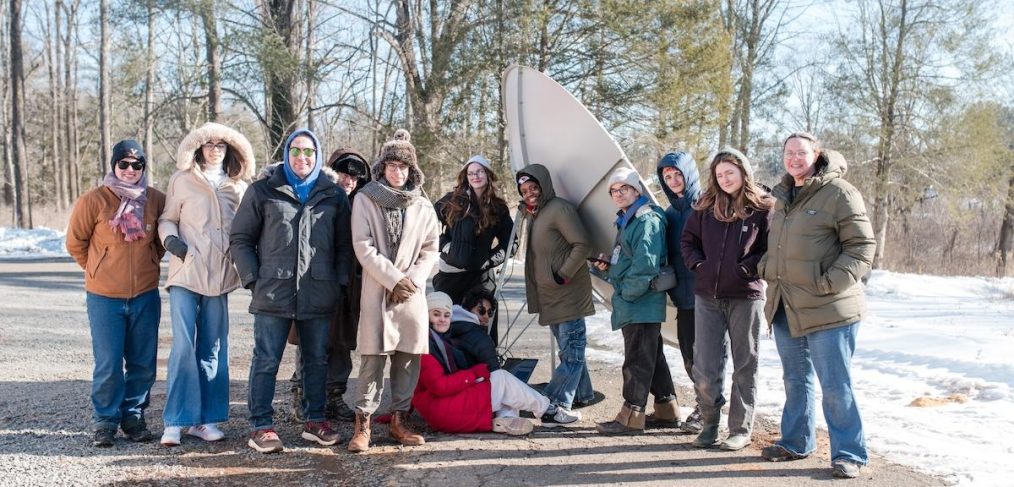
DC Space Grant Supports Artemis II Student Research Team
Fly Me to the Moon (For Science)
At 6:35 p.m. on April 1, NASA’s Artemis II rocket and Orion spacecraft lifted off from the Kennedy Space Center in Florida—beginning a journey further from our home planet than any human has ever traveled. Artemis II, NASA’s first crewed lunar mission since Apollo 17 in 1972, will carry its crew more than 240,000 miles around the far side of the moon.
Out among the stars, the crew will test systems for increasingly complex Artemis missions, which aim to return humans to the lunar surface and, eventually, send the first crewed mission to Mars.
The AU student-led team is one of just 34 global volunteers—and one of only eight university teams worldwide—selected by NASA for a citizen science initiative tied to the journey. After submitting their proposal in October 2025, the campus researchers will track radio waves emitted by the spacecraft during its 10-day mission.
“It’s pretty awesome to be part of this in an official capacity,” said Ankur Purao, CAS/BS ’26, SIS/BA ’26, who leads the team of 12 students and several faculty members. “This is 50 years in the making. Who knows when an opportunity like this will happen again?”
The direct involvement in a NASA mission of this magnitude marks a milestone for AU. The project is a collaboration between AU’s Physics and Mathematics and Statistics departments, and the NASA DC Space Grant Consortium, which has been headquartered on AU campus since 1999.
Read the full article on american.edu
Author Credit: Jack Frederick
Image Credit: Photo by Nikolai Roster, CAS.
Original Post Date: 4.1.26